Case Study - 2025
GoodLeap Pros Enterprise SaaS
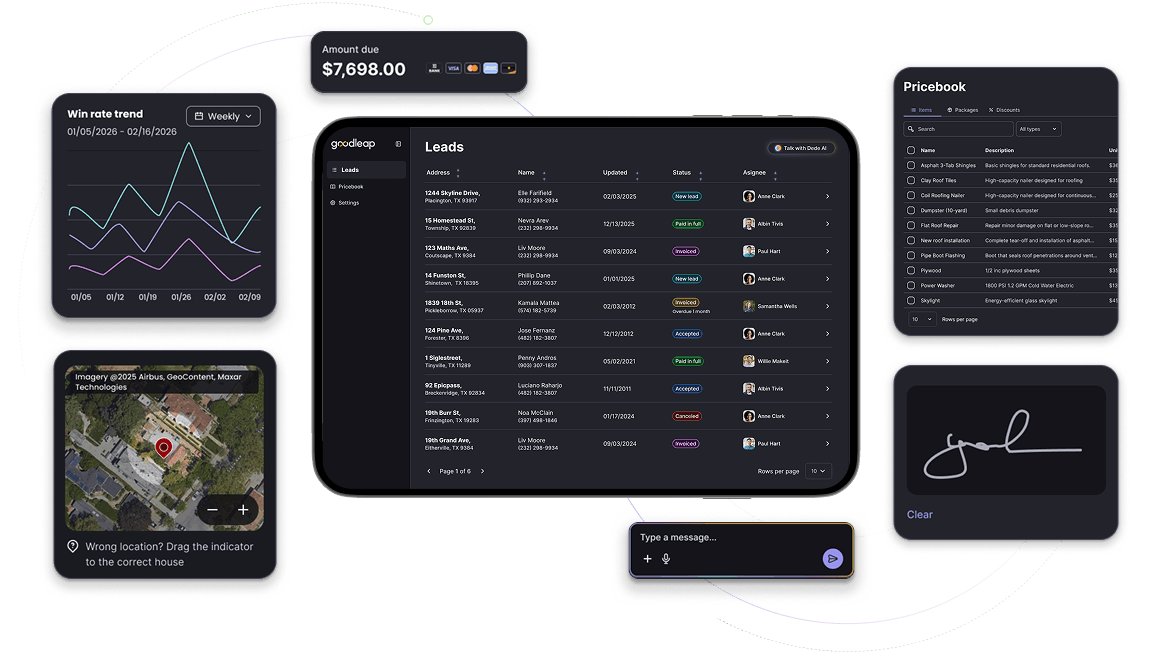
GoodLeap Pros is an Enterprise Roofing SaaS that I took from 0 → 1 in 6 months in 2025.
Built as a single platform for all roofing needs, Pros includes a proposal tool, pricebook, loans, contracts, invoices, and an interactive AI agent named DeDe.
My Role
Staff UX Designer • Sole Designer
Company
GoodLeap
The Problem
A hard pivot with a harder deadline
In early 2025, external factors forced GoodLeap to make a sudden strategic pivot from clean energy financing into roofing and HVAC. I had already invested 4 months into my original project, a proposal tool for solar installers, when the shift happened. This pivot forced me to start the project from scratch while retaining the same deadline.
As the sole designer, I owned everything: research, information architecture, design system, high-fidelity mockups, prototypes, and developer handoff.
Limited time
Six months to complete all design work. No room for delays or rework.
Research gaps
No time for new research. Every assumption needed to be explicit and testible
Fluid scope
Requirements shifted weekly as leadership learned the roofing industry alongside us.
No design system
The hard pivot came with a company-wide rebrand with no centralized design system.
Business Goals
- 01Enter a mature, competitive SaaS category as a credible player
- 02Open a new revenue stream from existing contractor relationships
- 03Launch at parity with competitors, then differentiate on financing + AI
- 04Post-launch NPS score above 30 within the first quarter of release
My Responsibilities
- 01End-to-end product design for seven core workflows
- 02Design system creation, governance, and handoff
- 03Stakeholder alignment and live scope negotiation
- 04Developer collaboration, implementation support, and QA
My Approach
A framework to balance speed and quality under pressure
I needed to work fast, but couldn't afford to be sloppy. I built a four-pillar operating model inspired by lean UX and agile methodologies to find a point of convergence between quality and speed.
Process Timeline · 6 months
Research
Turning AI-generated assumptions into testable hypotheses
With no time for upfront field research, I inverted the usual order. I used generative AI to build a first-pass research artifact set, then treated every output as an assumption that had to be confirmed or refuted against real data, on a rolling basis.
What I did
What I learned
Roofing sales reps live in their truck, meaning mobile and tablet use accounted for 70% of proposal creation.
Contractors fear loan rejection in front of the homeowner. Our financing flow had to show results fast to minimize ambiguity.
Measurement accuracy is the top admin burden. Roofers re-measure because they don't trust their tools or existing software.
I assumed users wanted a single universal template. Interviews said the opposite. Every franchise wanted their own branded flow.
North Star
Setting the long-term vision with early iterations
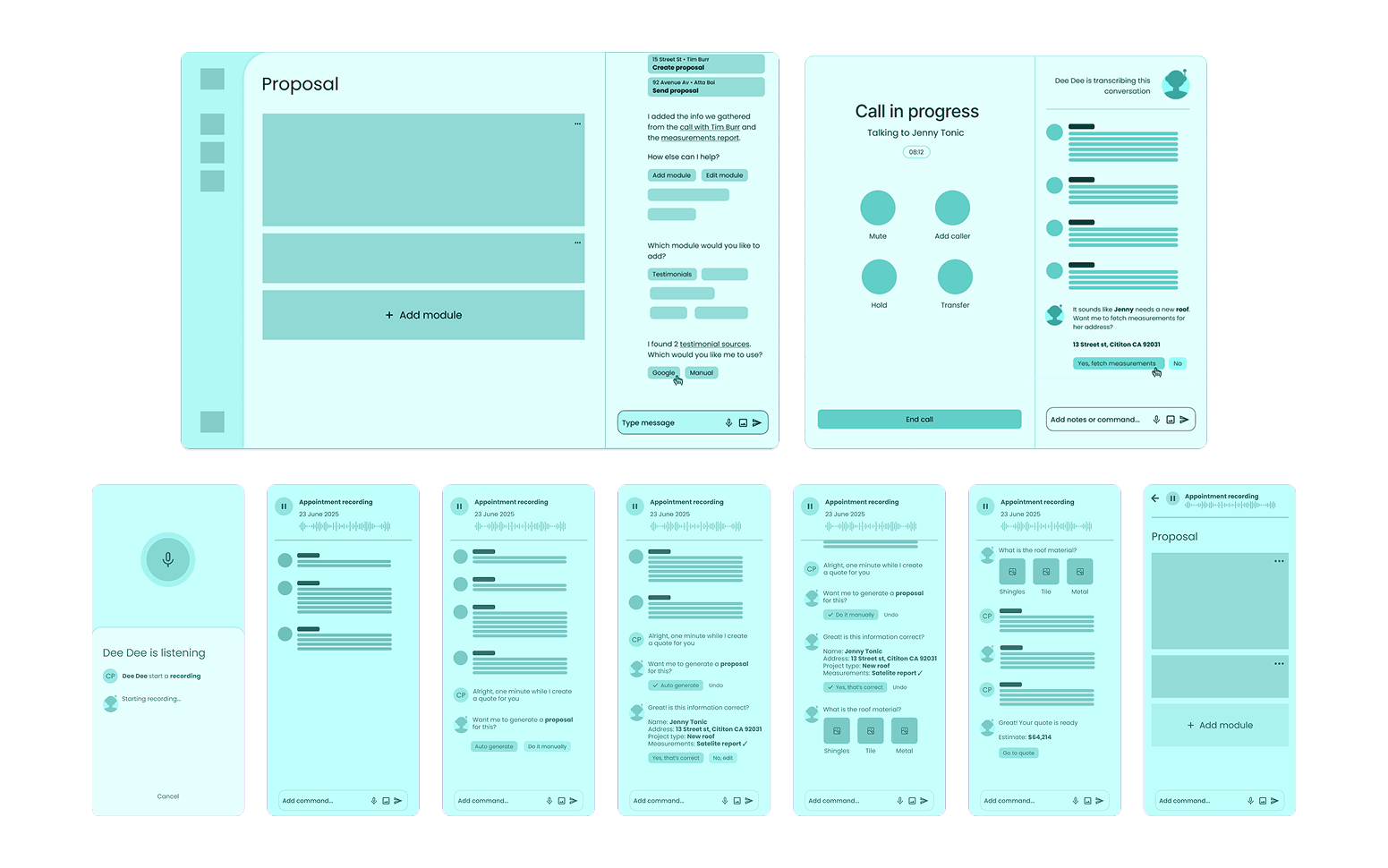
Before pixel-perfect work began, I built a North Star file consisting of low-fidelity wireframes covering every key feature. It let me align stakeholders on shape and intent without burning time on visual debates, and it became the reference the team returned to throughout the project.
Design System
Merlin - a system built in two weeks
GoodLeap had new branding, and expected a new system with GoodLeap Pros. I needed to move fast, so I took my own pre-built Figma template, Axil, and pulled GoodLeap brand tokens directly from their website. I refined the tokens for accessibility and updated my templated components to match. The system later became the seed for the company-wide DS.
Palette
Type
Components
Key Features
Seven key features, built fast to last
I rapidly built each of these features while moving quickly and constantly negotiating scope with leadership and engineering.
Each feature represents a phase in the roofing journey and is built to optimize the user experience within the context of that phase.
A personal assistant for all roofing needs.
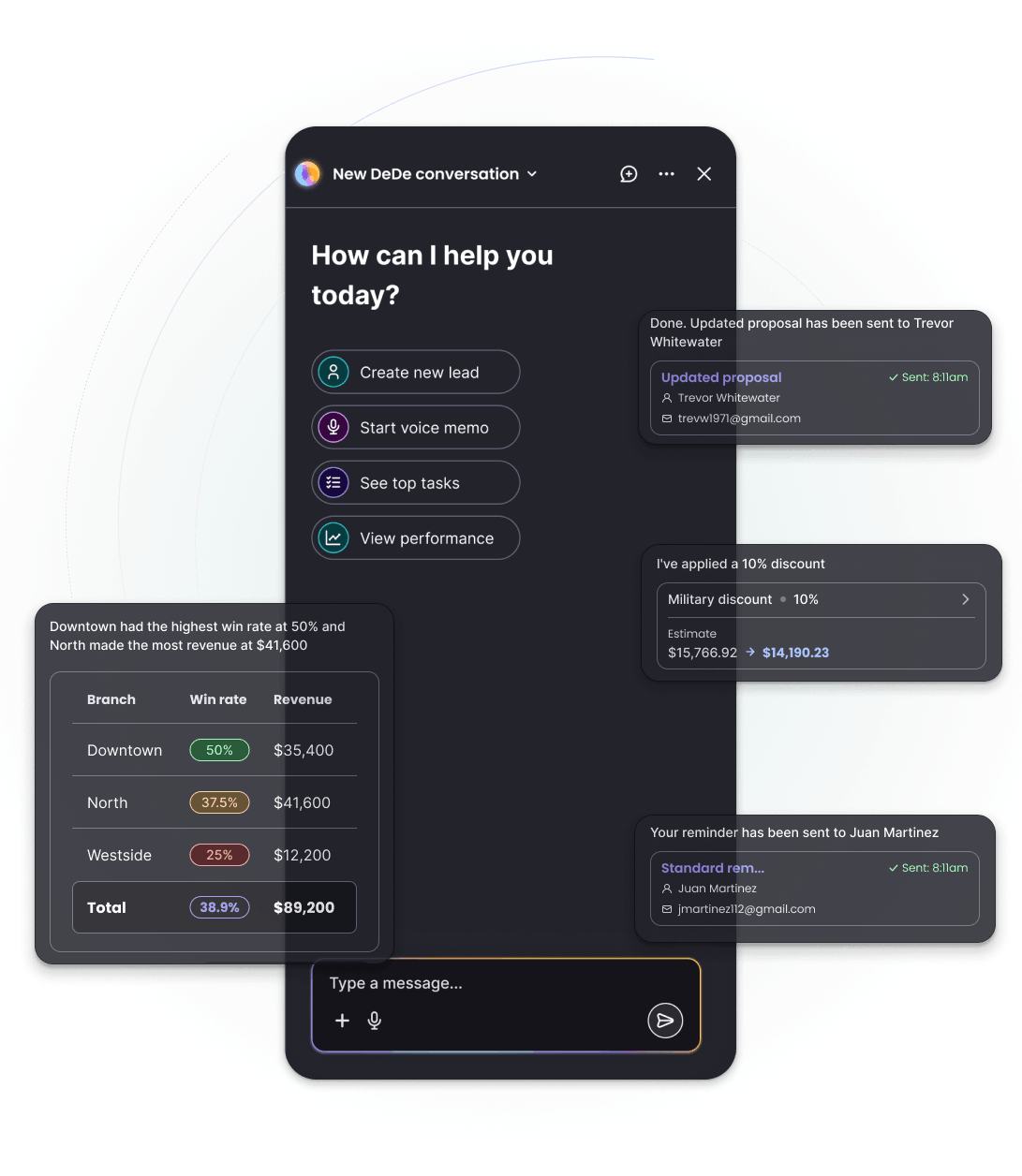
I led discovery and initial concepts for DeDe, our in-product AI. In a market oversaturated with chatbots, DeDe needed to stand out as a true AI assistant. I designed DeDe with a combination of agentic AI and reliable automation, creating an agent that can reliably help with all roofing needs.
- ●Fast proposal generaiton with minimal instruction
- ●Agentic performance statistics and visuals
- ●Smart automation built across workflows with simple English
- ●Voice memos with real-time transcription and integrated actions
Impact
Pre-launch results
At the time of publishing, this applicaiton hadn't gone live yet, so I don't have post-launch conversion metrics inluded. What I can speak to are the organizational and delivery outcomes that set launch up for success.
Qualitative Impact
Executive visibility
GoodLeap Pros became the flagship example of our department's ability to execute under pressure.
Team efficiency
The Figma template system cut handoff-revision cycles in half on later features.
Design system foundation
My design system was adopted (with adjustments) by three additional product teams.
DeDe precedent
Set the vision and use patterns for every AI feature that came after.
Vision alignment
Defined the long-term vision of roofing technology at GoodLeap
Innovation Definer
My designwork was the face of GoodLeap's 2026 Innovation Summit
Reflections
What went well and what I'd change
This project was a crash course in execution under pressure, and I'm proud of how I navigated the competing priorities, ambiguity, and sheer scope of it all. That said, there are definitely things I would have done differently in hindsight.
While I met my deadline for design work, the software ultimately did not launch on time. We simply had too small of a team and not enough time. If I could do it again, I'd push harder for more research and iteration time. I'd also impliment AI into my process sooner to cut down on wireframing and prototyping time.
What worked
- ●Parallel design tracks paid off in hitting my deadline.
- ●Shared the DS early and made developers partners, not recipientsl
- ●Early user testing overwhelmingly positive and surfaced no major issues.
What I'd change
- ●Earlier implimentation of AI in my design process.
- ●Negotiate explicit "flagship vs. MVP" bar with leadership sooner.
- ●Harder advocacy for more staff to cover the major scope increase.
What's next
- ●Data-based iteration using post-laumch analytics and user feedback.
- ●Run contextual inquiries to close the remaining research gaps.
- ●Revisit parking lot features and prioritize based on user needs and impact.